
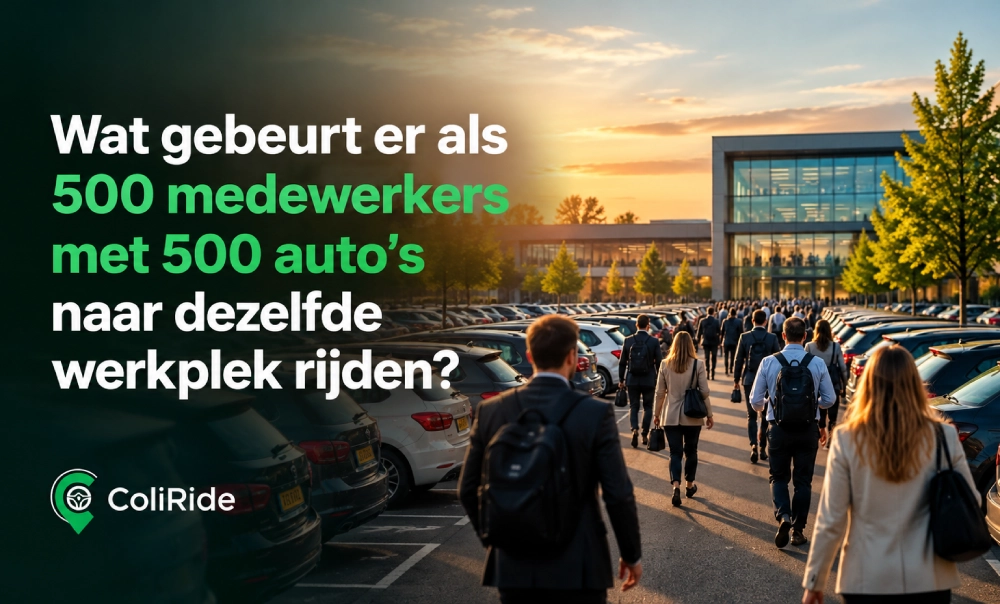
Imagine a company with 500 employees.
Every morning, 500 people leave their homes, get into 500 separate cars, drive toward the same workplace, and look for 500 parking spaces.
At the end of the day, the process happens again in reverse.
At first glance, this may simply look like 500 individual commuting decisions. From a business perspective, however, it creates a much bigger question: how efficiently is the company managing employee mobility?
Employee commuting affects parking demand, traffic around business locations, carbon emissions, accessibility, and potentially employee experience. In the Netherlands, its importance is increasingly recognized at policy level: organizations with 100 or more employees currently have reporting obligations covering business travel and employee commuting under the Work-related Personal Mobility (WPM) scheme (Netherlands Enterprise Agency [RVO], 2026).
So, what really happens when 500 employees arrive in 500 cars?
The most visible consequence is simple: every vehicle needs somewhere to go.
For companies with limited parking capacity, this can create pressure at the beginning and end of every working day. Additional parking also means land, infrastructure, maintenance, access management, and costs that could potentially be avoided or reduced.
Now change one variable.
If some employees travelling on compatible routes share their journey, fewer vehicles need to reach the workplace. Even modest increases in vehicle occupancy can therefore translate directly into lower parking demand.
Corporate carpooling is not about eliminating private cars. It is about using the available seats in those cars more efficiently.
An employee's commute may happen outside working hours, but its environmental impact does not necessarily sit outside corporate sustainability reporting.
Under the GHG Protocol, employee commuting is classified as Scope 3, Category 7. The guidance recommends collecting information such as commuting distance, transportation mode, commuting frequency and, where relevant, carpool participation and average vehicle occupancy (GHG Protocol, 2013).
The Dutch government has taken a similar interest in work-related mobility. RVO states that business travel and employee commuting together account for more than half of the kilometres driven in the Netherlands (RVO, 2026).
This means commuting patterns are increasingly relevant to organizations trying to understand—and reduce—their mobility-related emissions.
This is perhaps the most interesting part of the 500-car scenario.
Imagine that each vehicle has several seats, yet most of those seats arrive empty.
From a mobility perspective, that is unused transportation capacity.
Corporate carpooling approaches the problem differently. Instead of asking companies to provide hundreds of additional vehicles, it asks whether existing journeys can be connected more intelligently.
The GHG Protocol explicitly recognizes carpooling when calculating commuting emissions, including both the proportion of employees participating and average vehicle occupancy (GHG Protocol, 2013).
If two colleagues already travel from similar areas, at similar times, to exactly the same destination, sharing one journey can be far more efficient than making two separate ones.
Companies routinely measure energy consumption, fleet performance, office occupancy, and operational costs. Employee mobility is increasingly becoming another measurable business activity.
In the Netherlands, employers covered by WPM must collect data on work-related mobility so that associated CO₂ emissions can be calculated. RVO calculates emissions using passenger kilometres combined with emission factors for different transport and fuel types (RVO, 2026).
This creates an opportunity beyond compliance.
Understanding where employees travel from, how they travel, and where compatible journeys exist can help companies design smarter mobility policies.
A digital corporate carpooling platform can turn that information into action by matching employees according to factors such as location, destination, schedule, and commuting preferences.
Corporate mobility does not need an all-or-nothing solution.
Public transportation may work perfectly for one employee. Cycling may be ideal for another. Remote work may eliminate some journeys altogether. For employees who still need or prefer to travel by car, carpooling can provide another option.
The objective is not to force everyone into the same transportation mode. It is to make commuting more efficient where opportunities naturally exist.
For a company with hundreds—or thousands—of employees, small changes in average vehicle occupancy can potentially translate into fewer cars arriving each morning, lower parking pressure, and fewer commuting-related emissions.
When 500 employees drive 500 cars to the same workplace, the issue is not simply the number of cars.
It is the unused capacity inside them.
Every empty passenger seat represents a potential mobility opportunity. By connecting employees with compatible routes and schedules, companies can transform commuting from hundreds of disconnected individual journeys into a smarter mobility network.
The future of workplace mobility may not require more vehicles.
It may simply require making better use of the ones already on the road.
GHG Protocol. (2013). Technical Guidance for Calculating Scope 3 Emissions – Category 7: Employee Commuting. World Resources Institute & World Business Council for Sustainable Development.
Rijksdienst voor Ondernemend Nederland (RVO). (2026). Reporting obligation work-related mobility of persons (WPM). Ministry of Economic Affairs / Ministry of Infrastructure and Water Management.
Centraal Bureau voor de Statistiek (CBS). (2026). Mobility; per trip, modes of travel, purposes of travel and regions. CBS StatLine.