
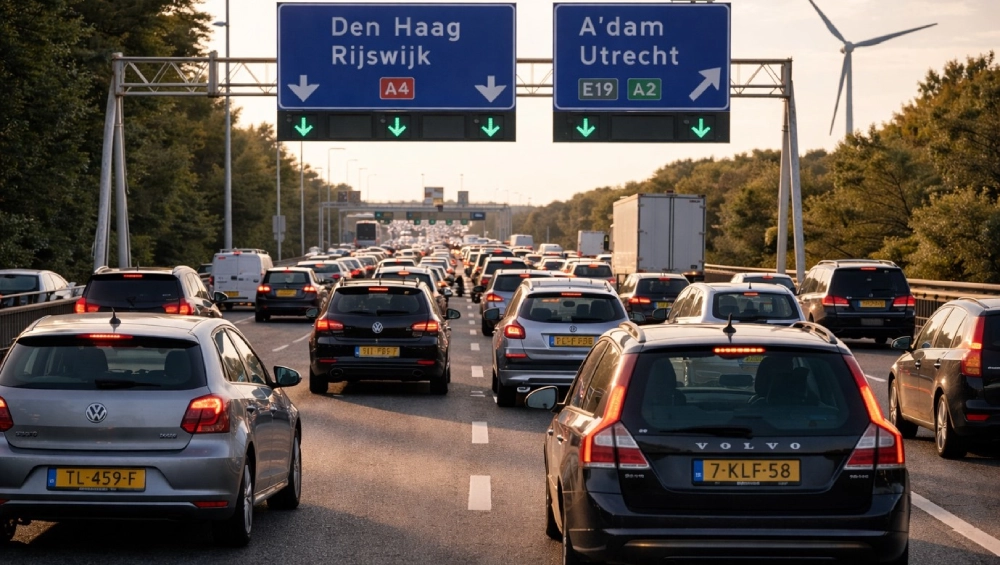
Monday morning. Your employees are sitting in the same traffic they sat in last week, and the week before that. Meanwhile, most of those cars have just one person in them. It’s a familiar picture and one that’s costing Dutch businesses far more than just fuel.
Congestion on Dutch roads costs the economy an estimated €4 billion a year in lost time and productivity. That’s not a small number. And despite world-class trains and cycling infrastructure, the morning rush isn’t getting any lighter.
Hybrid work was supposed to ease congestion. In some ways it did, but it also made travel patterns harder to predict. People no longer commute five days a week on the same schedule, which means roads get hit with irregular spikes rather than a steady flow that infrastructure can absorb.
The result? Congestion hasn’t disappeared; it’s just become more chaotic. For companies based around Amsterdam, Utrecht, or Rotterdam, this hits employees hard. Long, unpredictable commutes wear people down before the workday even begins.
Here’s something that’s shifted quietly over the last few years: commuting is now firmly on the employer’s agenda.
Partly that’s driven by ESG. Under the EU’s Corporate Sustainability Reporting Directive, larger companies need to report on Scope 3 emissions and employee commuting sits right in that bucket. Partly it’s about talent. People increasingly factor in how they get to work when deciding where they want to work. The Dutch government has been responding to this through its Mobiliteitsvisie 2050 strategy, which sets out a national vision for cleaner, smarter travel. Tax-friendly commuting allowances have been in place for years, but more recently, regional governments and municipalities have started actively funding employers who take structured steps to reduce single-occupancy car trips.
Carpooling isn’t a new idea, but the way it’s being implemented now is genuinely different. It’s no longer about pinning a note to the office noticeboard asking if anyone lives near Amstelveen.
Today, structured carpooling means matching employees intelligently based on location, schedule, and route, and giving companies the data they need to track the impact. It reduces the number of cars arriving on site, cuts commuting costs for employees, and produces the kind of measurable emissions reductions that ESG teams can actually report on.
Some Dutch regional programs now specifically support employers who integrate carpooling into their mobility plans. That makes it both a smart sustainability move and, in some cases, a fundable one. ColiRide was built to help companies take exactly this kind of structured approach turning a good idea into something that actually works at scale.
The policy support is there. The technology is there. And frankly, the pressure, from regulators, from employees, from investors, is only growing.
Companies that get ahead of this now won’t just tick an ESG box. They’ll make a real, visible difference to how their people experience works every single day. And that’s worth more than most mobility budgets people realize.