
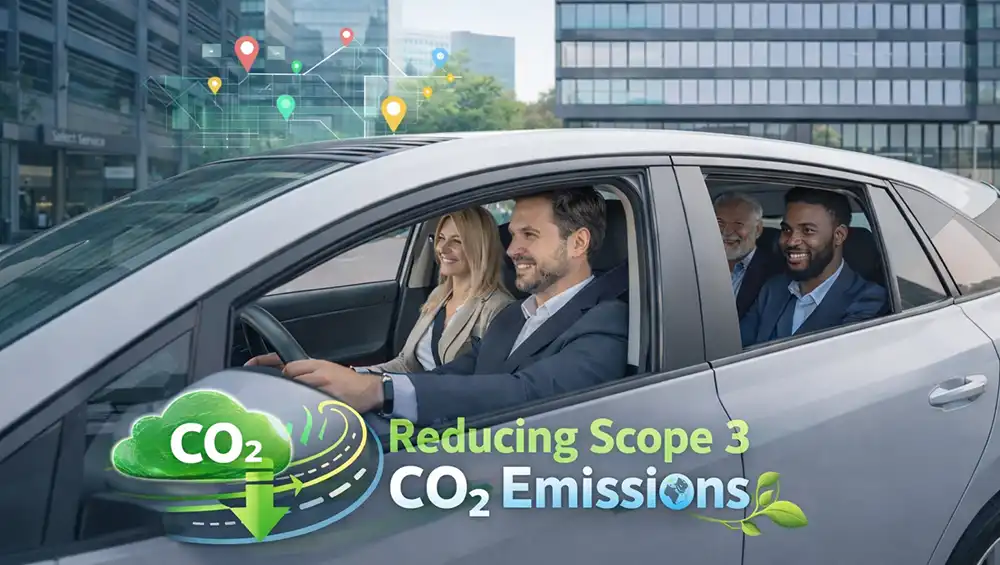
As we move through 2025, corporate sustainability has shifted from voluntary pledges to rigorous compliance. For many organizations, the “low-hanging fruit” of Scope 1 and 2 emissions (like switching to renewable energy in offices) has already been harvested. The new frontier is Scope 3: the indirect emissions that occur in a company’s value chain. Specifically, Scope 3, Category 7 (Employee Commuting) is often the single largest source of emissions a company doesn’t directly own but generates every day (Asuene, 2025).
For logistics and fleet managers, this presents a unique challenge: How do you reduce carbon output from vehicles you don’t control? The answer lies in modernizing shared mobility.
The environmental argument for carpooling is supported by compelling data. A typical solo commuter in a combustion-engine vehicle can emit significant amounts of CO₂ annually. In contrast, regular carpooling can save approximately 0.45 to 2.1 tons of CO₂ per employee per year, depending on frequency and vehicle type (RideAmigos, 2025).
To put this in perspective: shifting just three employees from solo driving to a single shared vehicle reduces per-capita commute emissions by approximately 66% immediately. Unlike complex supply chain overhauls that take years, this is a reduction that happens the moment the car door closes.
In the past, carpooling was an informal arrangement limited by whoever lived next door. Today, B2B platforms use geospatial analytics and AI-driven matching to unlock efficiencies that manual coordination never could.
Regulatory pressure is tightening globally. In many regions, companies with over 100 employees are now required to report on commuter mobility patterns. A structured carpooling program turns a compliance headache into a strategic asset. By actively reducing parking demand and vehicle miles traveled (VMT), companies can preemptively meet stricter local air quality zones and carbon taxes (Evo Moov, 2025; ICT Group, 2024).
To turn potential savings into actual carbon reduction, companies need to move beyond passive encouragement:
Reducing corporate carbon footprints doesn’t always require massive infrastructure projects. Sometimes, it just requires filling the empty seats already moving toward your office. By formalizing carpooling, you don’t just help the planet; you build a more connected, resilient, and data-savvy organization.
Asuene (2025). Scope 3 Category 7: Employee Commuting. Available at: https://asuene.com/us/blog/scope-3-category7-employee-commuting
Evo Moov (2025). Smart Mobility, The New Performance Engine for Companies. Available at: https://evomoov.ch/en/lab-mobilite/intelligent-mobility-:-the-new-engine-of-company-performance
ICT Group (2024). Value Chain Analysis – Employee Commuting 2024. Available at: https://www.ict.eu/sites/corporate/files/documents/CO2Prestatieladder/ICTG_CO2PL_4A1+4B1_Employee%20Commuting_V4.0.pdf
KPMG (2025). CO2 Performance Ladder report 2024/2025. Available at: https://assets.kpmg.com/content/dam/kpmg/nl/pdf/over-ons/co2-performance-ladder-report-2024-2025-kpmg.pdf
Muto Mobility (2025). Corporate Mobility Trends 2025: EVs, Data & Flexibility. Available at: https://mutomobility.com/resources/driving-change-corporate-mobility-trends-shaping-2025
Nature (2025). Quantifying carbon reductions from mode substitution. Available at: https://www.nature.com/articles/s41598-025-22719-3
RideAmigos (2025). Why Corporate Carpooling is a Climate Game-Changer. Available at: https://rideamigos.com/blog/why-corporate-carpooling-is-a-climate-game-changer/